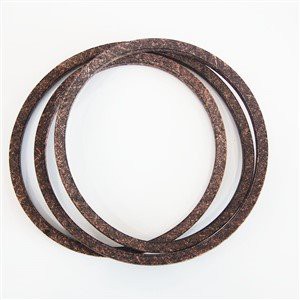
If you’ve ever tried to figure out why a banded wedge belt isn’t just another run-of-the-mill V-belt, you’re not alone. I get questions about this all the time from mechanics, industrial maintenance techs, and even small shop owners who are tired of belts slipping, breaking, or wearing out way too fast. Let’s break down what the “band” in banded wedge belt actually means—and why it’s the secret that makes these belts work so much better than regular ones.
First, let’s start with the basics: V-belts have been around for decades, right? You’ve probably seen them in car engines, lawn mowers, or conveyor systems. They’re shaped like a wedge, so they fit snugly into the grooves of pulleys, creating friction that transfers power from one part to another. But even good old standard V-belts have a flaw: if you’re running equipment that’s under a lot of load, or pulleys that are smaller than they should be, those belts can flip, twist, or split apart over time. That’s where the “band” comes in.
The band is a continuous, tough layer wrapped around the back of multiple wedge belts that are fused together. Wait, let me make that clear: it’s not just a single belt with a strip glued on. It’s several narrow wrapped V-belts (you can check more on that here /v-belt/wrapped-belt/narrow-wrapped-belt.html) stacked side by side, then held together by that top band. This design fixes two big problems with single V-belts: lateral stability and load distribution.
Think about a single V-belt running a heavy-duty conveyor. If the load shifts to one side, the belt can twist in the pulley groove, which causes slippage, heat build-up, and eventually, the belt snapping. The banded wedge belt’s band prevents that twisting—all the individual wedge belts are locked in place, so they move as a unit. That means even under uneven load, the belt stays where it’s supposed to, no slipping, no unnecessary stress on the fibers inside.


The other big plus with the band? It spreads the load evenly across all the belts in the assembly. A single V-belt has to handle all the tension and power on its own, which means it wears out faster, especially in high-torque applications. Banded belts split that work between 2, 3, or even 4 individual belts, so each one takes a smaller share. That’s why they last longer. I’ve seen customers swap out a single belt every 3 months, switch to a banded wedge belt, and only have to check it once a year. That’s a huge time and cost saver for anyone running equipment around the clock.
Now, let’s talk about why it’s a “wedge” belt specifically. Wedge belts are narrower than traditional V-belts, so they fit into smaller pulleys without the same risk of slipping. Combine that with the band, and you’ve got a belt that’s compact, stable, and perfect for space-limited setups—like garden equipment, for example. Speaking of which, wrapped V-belts for garden technic (here’s a link to see that niche use /v-belt/wrapped-belt/wrapped-v-belts-for-garden-technic.html) often use banded designs because lawn mowers, tillers, and small tractors have tight pulley spaces and irregular loads from grass, dirt, and uneven terrain. The band keeps the belt from slipping when you hit a thick patch of grass, and the narrow wedge shape fits right into those small pulleys without wasting space.
I know some people might wonder: why not just use a regular durable V-belt (/v-belt/wrapped-belt/durable-v-belt.html) instead? Durable V-belts are great for lighter loads or steady applications, but they don’t have the stability of a banded belt. If you’re running a motor drive that’s pulling a heavy load through a small pulley, a single belt will heat up more, stretch faster, and break sooner. Banded belts handle heat way better too—because the multiple belts in the assembly disperse heat more evenly than a single thick belt. That means less wear from thermal breakdown, which is a common issue with belts that run continuously, like conveyor systems or industrial pumps.
Let me share a quick story that illustrates this. A customer of mine who runs a local manufacturing plant was using standard V-belts on their conveyor system. They were changing belts every 6 weeks because the belts would twist and snap when the conveyor carried heavy pallets of parts. I suggested they switch to banded V belts (/v-belt/wrapped-belt/banded-v-belts.html) instead. A year and a half later, they still haven’t had to replace a single one. The plant saved thousands in labor and replacement costs, not to mention the downtime they used to have when a belt broke mid-shift. That’s the kind of real-world difference the band makes.
Wait, let’s get into the nitty-gritty of what the band is made of, because not all bands are the same. A good band is usually made of a high-tensile synthetic fiber—like polyester or aramid—wrapped in a durable rubber compound. It’s not just glued on; it’s vulcanized to the top of the individual wedge belts, so it’s part of the whole assembly, not an afterthought. That’s why cheap imitations fall apart: their band is just a thin strip glued on, so it comes off under load, and the individual belts separate. As a supplier, I only work with belts where the band is integrated, not just attached. That’s how you get the stability and longevity you need for motor drive belts (/v-belt/wrapped-belt/motor-drive-belts.html) or any high-demand application.
Another thing people don’t always realize: the band also protects the internal fibers of the wedge belts. Those fibers are what give the belt its strength, and if they’re exposed to oil, dirt, or extreme temperatures, they can degrade. The band acts as a barrier, so only the bottom part of the belt (the part inside the pulley groove) comes into contact with whatever’s in your equipment. That extends the life of the belts even more, especially in harsh environments like farms, construction sites, or manufacturing plants with lots of dust and fluids.
Let’s clear up a common mix-up: banded wedge belts aren’t the same as raw edge belts, even though some people use the terms interchangeably. Raw edge belts have a cut top edge, no covering, which makes them flexible for small pulleys. But they don’t have that top band, so they’re more prone to twisting. Banded belts take that raw edge flexibility and add the stability of the band, making them a middle ground that’s perfect for most industrial and small engine applications.
If you’re still on the fence about whether a banded wedge belt is right for your setup, ask yourself a few questions: Is your equipment running heavy loads? Are your pulleys smaller than the manufacturer’s recommendation? Do you have issues with belts slipping or twisting? If you answered yes to any of those, the “band” isn’t just a part of the belt—it’s the reason you should switch. It’s the feature that turns a good belt into a reliable one, the kind that doesn’t leave you stuck in the middle of a job waiting for a replacement.
At the end of the day, I see too many people cutting corners on belts to save a few bucks, only to spend way more on downtime and replacements. A banded wedge belt is an investment in reliability. It’s not just a V-belt with a strip on top—it’s a designed solution that solves common belt problems for good.
If you’re looking to upgrade your belts, or just have questions about which banded wedge belt will work for your specific equipment, feel free to reach out to us. We’ve helped everything from small garden tractors to large industrial conveyors run smoother, and we’re here to help you find the right fit. Whether you need a replacement for your lawn mower, a new set for a factory motor, or something for a specialty application, we’ve got durable options that use the integrated band design to keep your equipment running.
References
- Machine Design: Power Transmission Belt Basics, Society of Manufacturing Engineers, 2022.
- Industrial Belt Technology: Selection and Application, Belt Manufacturers Association, 2021.
- Small Engine Belt Systems: Maintenance and Replacement Guidelines, Outdoor Power Equipment Institute, 2023.
- Heat Generation and Distribution in Power Transmission Belts, Journal of Mechanical Design, Vol. 145, No. 8, 2023.