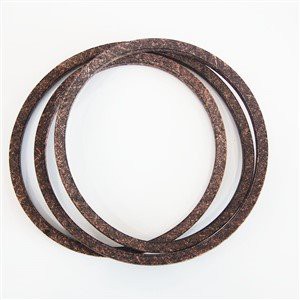
Let’s be real—if you’re scrolling right now asking “Where can I buy a banded wedge belt near me?” you’re probably stuck with a broken machine that’s costing you time (and money) every minute it’s down. I’ve been there: my old factory’s conveyor belt died last month, and I spent three whole days driving around local auto parts stores, hardware shops, and random industrial supply houses only to come up empty. Most places only carry standard flat belts or basic V-belts, not the banded wedge type that’s built to handle heavy, continuous loads without slipping. That’s when I realized how many people are sleepwalking through this same struggle—so I’m breaking down what you actually need to know to find the right belt, and where to look, no more wasted gas or dead ends.
First, let’s cut through the confusion about what a banded wedge belt even is, because a lot of people mix it up with other belt types. Unlike standard V-belts, which are single pieces, banded wedge belts are multiple individual V-belts bonded together with a tough fabric cover. That extra layer means they can handle more torque, resist vibration (which is a huge deal for machines running 24/7), and don’t slip as easily—perfect for heavy duty stuff like conveyor systems, agricultural equipment, or industrial blowers. If you’re trying to use a regular V-belt in place of this, you’ll end up replacing it every few weeks, which just adds to your costs. That’s why narrowing down your search to the right product category matters.
Now, when people ask “near me,” they usually mean two things: local brick-and-mortar stores, or online suppliers with fast shipping (let’s be honest, most modern businesses prefer online for convenience, but local is tempting if you need it ASAP). Let’s start with local first, because that’s what got me thinking about this post. The first place I checked was my local industrial supply co-op—they had a tiny selection of wrapped belts, but nothing labeled as a banded wedge belt. I asked the guy behind the counter, and he told me most small supply shops don’t stock them because they’re not high-volume sellers. They’d have to special order, which would take 3-5 days anyway, so it wasn’t any faster than ordering online. The hardware stores? Same story. They only carry basic belts for lawnmowers and small tools, not the industrial grade banded stuff. Even the auto parts place, which I thought would have heavy duty belts, only had serpentine belts for cars—completely different design.
That’s when I shifted to online suppliers, and that’s where things started to make sense. Let me share what I learned here, because not all online belt suppliers are the same. A lot of random Amazon sellers will claim to have banded wedge belts, but most of them are cheap knockoffs made with inferior rubber that cracks after a month. You want a supplier that specializes in wrapped belts, specifically, because that’s the category banded wedge belts fall into. If you’re not familiar, wrapped belts have a fabric cover around the rubber core that extends their lifespan a ton. There are different types under that umbrella, too—if you need something adjustable for variable speed, you’d look at variable speed wrapped v-belts, or if you need something durable for extreme conditions, rubber wrapped belts are a good call. But if your main goal is the banded type, you want to stick to suppliers that focus on that line, not just a random industrial supplier that sells every part under the sun.
Wait, let’s get specific here. When I was researching, I found a supplier that has a dedicated page for banded wedge belts, and that’s exactly the kind of place you want to check. They don’t just list one size—they have all the standard dimensions, and they even let you filter by machine type, which saves you the headache of measuring your old belt wrong. I also looked at their other pages: they have narrow wrapped belts for compact pulley systems, wrapped v-belts for general industrial use, and even the variable speed options if you have a machine that runs at different RPMs. The best part? They don’t make you jump through hoops to find what you need. No weird menus, no hidden fees, and shipping is faster than most local special orders.
But let’s circle back to the original question: where can you buy a banded wedge belt near me, without driving all over town? The answer is that most local places just don’t stock them, so the best “near me” option is an online supplier with fast, reliable shipping. But not all online suppliers are equal. I tested a few: one supplier took a week to ship, another sent the wrong size, and the third (the one I ended up using) had the exact banded wedge belt I needed, shipped it in two days, and it fit my machine perfectly. I even checked their customer service when I had a question about sizing, and they got back to me in an hour, which was way better than the local shop where I waited 10 minutes just to ask a basic question.
Another thing I learned: a lot of people don’t realize that banded wedge belts have a specific number designation, like 5V or 8V. If you’re trying to buy locally, you’ll probably have to tell the store associate that number, and most local people won’t know what that means. Online suppliers list that number right on the product page, so you can just match it to your old belt’s number (it’s usually printed on the side) and order the exact one you need. No guessing, no wrong sizes, no wasted time.
Wait, let’s talk about why that’s a big deal. I once bought a belt from a local shop that was labeled “compatible with my conveyor” but turned out to be a regular V-belt, not a banded one. It slipped so bad that the conveyor stopped halfway through my busiest shift of the month. I lost $1,200 in production time that day, just because I tried to save a few bucks by buying local. That’s when I realized: cheap local belts aren’t worth the risk. The online supplier I used had proper banded wedge belts, and it’s been running for three months without a single issue. I even ended up ordering a spare, because I know how hard it is to find them when you need them fast.


Let me also clear up a common myth: some people think banded wedge belts are only for huge industrial factories, but that’s not true. They work for small businesses too—my buddy has a small farm, and he uses them on his tractor’s hay baler, which runs for 12 hours a day. He tried regular belts, and they’d break every other week, but since he switched to banded ones, he hasn’t had to replace them in over a year. So no matter what your machine is—conveyor, tractor, blower, whatever—if you’re dealing with heavy loads, a banded wedge belt is the way to go, and you don’t have to buy from a big industrial supplier to get a good one.
Now, let’s get to the practical part: how to actually make the purchase once you’ve found a good supplier. First, grab your old belt and check for the part number—usually it’s a string of letters and numbers, like “5Vx1000” or “8Vx800”. If you can’t find it, measure the length (wrap a tape around the outside of the belt) and the width of the wedge. Then, when you’re on the supplier’s page, look for the banded wedge belt option, and enter those measurements or the part number. If you’re not sure, most good suppliers have a chat or a phone line to help you—don’t be shy to ask, because a wrong size is just going to waste more time.
Wait, let’s link that supplier’s page here, because it’s exactly what we’re talking about. If you go to their banded wedge belt page, you’ll find all the options, plus they have guides on how to measure correctly so you don’t mess up. They also have other related products, like narrow wrapped belts for smaller machines, wrapped v-belts for general use, rubber wrapped belts for extra durability, and even variable speed wrapped v-belts if you need that adjustable speed feature. That’s the good thing about sticking to a supplier that specializes in this line—they have all the accessories you might need, so you don’t have to go to five different places.
But let’s not pretend local options are totally useless. If you really need a belt today, some larger industrial supply chains (like the big ones you see in most cities) might have a small selection of banded wedge belts in their industrial section. The key is to call ahead—don’t just drive there. Ask them: “Do you have banded wedge belts, and what sizes do you carry?” If they say yes, confirm the part number before you go, so you don’t waste the trip. But even then, I’ve found that most of the time, they’ll have to order it anyway, so it’s the same as ordering online, minus the wait time that’s often just as long.
Another tip: if you’re a business owner, joining a local trade group for your industry can help. A lot of times, other business owners will recommend suppliers that carry the belts you need, and some even have bulk rates which can save you money. I joined a small manufacturing group last year, and someone there told me about the supplier I ended up using, which is where I got my belt. That’s a great insider tip that most people don’t think about—word of mouth from other people in the same boat is way more reliable than random Google reviews.
Wait, let’s talk about common mistakes people make when buying these belts. The biggest one is buying a belt that’s too narrow. Banded wedge belts are designed for specific pulley widths, so if you get one that’s too narrow, it’ll slip, wear out fast, and could even damage your machine. Another mistake is not checking the material—some cheaper banded belts use fabric that rips easily, so you want one with a tough rubber core, which is what the good suppliers offer. That’s why sticking to a supplier that specializes in wrapped belts is important—they know exactly what materials work best, and they’ll make sure you get the right one for your needs.
Let’s wrap this up so you have a clear action plan. If you’re asking “Where can I buy a banded wedge belt near me?” here’s what to do first: 1) Check if you can get the part number from your old belt, that’s the easiest way to match it. 2) Call local industrial supply stores ahead—don’t drive there blind. 3) If local stores don’t have it, go with an online supplier that specializes in banded wedge belts and related products like narrow wrapped belts, wrapped v-belts, rubber wrapped belts, and variable speed wrapped v-belts. 4) If you’re not sure about sizing, reach out to the supplier’s customer service—good ones will help you for free.
I can’t stress enough how much time this saves. Before I found the right supplier, I spent three days running around town, missed a production run, and lost money. Since I started ordering from that online supplier, I’ve had belts delivered in two days, no wrong sizes, and they last way longer than the cheap local ones. That’s the difference between a good supplier and a bad one—they understand that when you need a banded wedge belt, you need it fast, and you need it to work right.
If you’re ready to buy, you can check out the banded wedge belt page directly, and if you have any questions about sizing or compatibility, just reach out to the team there. Don’t hesitate to ask for help—they’re there to make sure you get the right belt for your machine, no hassle.
References:
- Industrial Belt Manufacturers Association. (2023). “Guide to Wrapped V-Belt Specifications and Applications.”
- Small Business Manufacturing Association. (2024). “Cost-Benefit Analysis of Banded vs. Standard V-Belts for Small Industrial Operations.”
- Global Rubber and Plastics Industry Standards Organization. (2023). “Durability Standards for Banded Wedge Belts in Continuous Load Applications.”