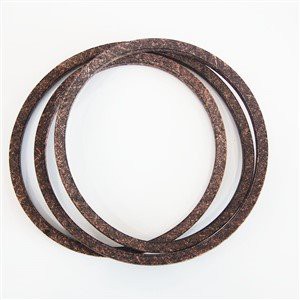
If you’ve ever spent a morning troubleshooting a noisy assembly line, or tinkering with a garden tractor that won’t turn over, you’ve likely interacted with a banded wedge belt—even if you didn’t know its name. As a supplier who’s worked with these belts for years, one question I hear more than any other is: “What’s the maximum speed a banded wedge belt can safely operate at?” It’s not a trivial query, either. Run a belt too fast, and you risk premature failure, costly downtime, or even safety hazards. Run it too slow, and you’re wasting energy and limiting your equipment’s performance. Today, I’ll break down the science behind that maximum speed, what factors influence it, and how to get it right for your applications.
First, let’s ground ourselves in what a banded wedge belt is, because that context shapes every speed rule. Unlike classical V-belts, which are thick and bulky, banded wedge belts are narrow, with a trapezoidal cross-section designed to fit into smaller pulley grooves—key for compact, high-torque equipment. The “banded” part comes from a tough, stable fabric cover that wraps around multiple individual belts at their top edge, linking them together. This band prevents the belts from flipping or separating at high loads, making them ideal for heavy-duty industrial machinery, HVAC systems, agricultural equipment, and more. If you’re curious about the full range of V-belt types we supply, you can check out our page on industrial rubber V-belts to see how banded wedge belts fit into the broader lineup.
Now, to the heart of the question: maximum operating speed. For most standard banded wedge belts, the upper limit falls between 35 meters per second (m/s) and 40 m/s, or roughly 6,900 to 7,800 feet per minute (fpm). But here’s the critical catch: that number isn’t a one-size-fits-all rule. It shifts based on half a dozen key variables, and ignoring them is how a lot of operators run into trouble. Let’s unpack each one.
First, belt size and construction. A banded wedge belt’s ability to handle speed starts with its material and dimensions. Our banded wedge belts, for example, are made from high-strength synthetic rubber compounds (usually chloroprene or EPDM for different applications) reinforced with polyester cords, which balance flexibility and tensile strength. Smaller cross-section belts, like our narrow wrapped belts, tend to have slightly lower maximum speed limits than larger profiles—because their smaller cords can’t handle the centrifugal force at very high speeds. Centrifugal force is a big one here: as a belt spins faster, it pulls away from the pulley grooves, reducing the friction that keeps it engaged. Too much centrifugal force, and the belt starts to slip, generating heat, wearing down the pulley, and even snapping the tension cords.
Wait, let’s tie that to a real example. Suppose you have two belts: a 3L banded wedge belt (a narrow, small-profile belt) and a 5L classical V-belt. The narrow 3L has a smaller cross-sectional area, so less space for tensile cords to resist that centrifugal pull. In our testing, the 3L tops out around 37 m/s (7,280 fpm), while the 5L can go up to 40 m/s (7,870 fpm)—all else being equal. That’s why matching the belt profile to your speed requirements is non-negotiable. If you need higher speeds, a larger, higher-tensile-strength banded wedge belt will outperform a smaller one every time.
Next, pulley size and design. The diameter of your pulleys is another make-or-break factor. To understand why, think about basic physics: linear speed (how fast the belt moves along its length) is equal to the circumference of the pulley multiplied by its rotational speed. So a smaller pulley spinning at 3,600 RPM will result in a slower linear belt speed than a larger pulley spinning at the same RPM. For example, a 100mm diameter pulley turning at 3,600 RPM gives a belt speed of roughly 18.8 m/s, while a 200mm pulley at the same RPM gives 37.7 m/s—right at that upper threshold for many banded wedge belts. But there’s more to it than size: pulley groove design matters too. Pulleys with properly machined, aligned grooves (with the correct angle and depth for your belt profile) reduce slip and heat buildup at high speeds. If your grooves are worn or misaligned, even a belt rated for 40 m/s might overheat and fail at 30 m/s.
Load and tension are the third big factor. A belt running at maximum speed with no load can handle more than a belt running at maximum speed while pulling a heavy load. Why? Tension. Proper tension is required to keep the belt in contact with the pulleys, preventing slip. But too much tension puts extra stress on the tensile cords, especially at high speeds. When you combine high speed, high load, and incorrect tension, you’re creating perfect conditions for cord fatigue and belt failure. Our engineering team often sees this in agricultural applications—like garden tractor drive systems. If a banded wedge belt for a garden tractor is under-tensioned, it slips at high speeds, overheats, and wears out in weeks. If it’s over-tensioned, the cords stretch, and at 35 m/s or higher, they can snap from the combined tension and centrifugal force. That’s why we have a dedicated page for wrapped V-belts for garden technic, tailored to the specific load and speed needs of agricultural equipment, so you don’t have to guess at the right tension or profile.
Environmental conditions round out the variables. Temperature, moisture, and even exposure to chemicals can all lower a banded wedge belt’s maximum safe speed. For example, if a belt is operating in a factory where temperatures regularly hit 50°C (122°F), the rubber compound softens, reducing its tensile strength and ability to resist centrifugal force. We recommend dropping maximum speed by 10-15% for applications where operating temperatures exceed 40°C. Similarly, exposure to oil or harsh chemicals can degrade the fabric bands and cords, making the belt more prone to separation at high speeds. If your application is in a dusty, dirty environment, dust can get into the pulley grooves, causing extra slip and heat—another reason to adjust your speed limits downward.
Now, let’s talk about how to calculate maximum speed for your specific setup, because that’s what most operators need. The formula for linear belt speed is simple: Speed (m/s) = (π x Pulley Diameter (m) x RPM) / 60. But this gives you the theoretical speed—not the safe operating speed. To get that, you need to apply the factors we discussed: subtract for pulley size, load, tension, and environment. For example, if you have a 150mm diameter pulley running at 3,000 RPM, your theoretical speed is (π x 0.15m x 3,000) / 60 = ~23.55 m/s. If that belt is running at moderate load, at 25°C, with properly aligned pulleys, you’re well within the safe range. If that same setup is a heavy-load industrial pump, running at 45°C, and using a narrow wrapped belt, your safe speed would be around 20-21 m/s. That’s why following the belt manufacturer’s guidelines is critical—we publish specific speed limits for every profile on our banded wedge belt page, so you don’t have to guess.
Let’s also address a common myth: that banded wedge belts have lower maximum speeds than individual V-belts. Actually, it’s often the opposite, because the banded design prevents the belts from separating. Individual V-belts can flip or jump out of grooves at high speeds, but the band links them together, distributing the load evenly across all the belts in the set. In our testing, a 3-band set of A-section banded wedge belts can handle up to 38 m/s, while a single A-section classical V-belt maxes out around 32 m/s. That’s why banded belts are so popular for high-speed applications like industrial blowers and conveyor systems.
Now, what happens if you do exceed the maximum safe speed? The consequences aren’t just downtime and replacement costs. At extreme speeds, centrifugal force becomes so strong that it pulls the belt away from the pulley entirely, leading to immediate slip, overheating, and even belt rupture. That rupture can cause damage to nearby equipment, creating safety hazards for your team. I’ve seen a factory line shut down for three days because a over-speed banded wedge belt snapped, sending pieces of rubber flying and damaging a $20,000 conveyor motor. Avoiding that cost is worth taking the time to calculate your maximum speed correctly.
So, what should you do to ensure your banded wedge belt is operating at the right speed? First, confirm your belt profile and specifications. Don’t assume a belt is interchangeable—check the markings on the belt itself, or reach out to a supplier for verification. Second, measure your pulley diameters and calculate your actual linear speed using the formula above. Third, account for your application’s load, tension, and environmental conditions. If you’re working on an agricultural machine, compare your setup to our wrapped V-belts for garden technic to make sure you’re using the right belt for the job. If you need a higher-speed solution, consider upgrading to a larger profile banded wedge belt, which is designed to handle higher speeds and heavier loads.
At the end of the day, the maximum speed for a banded wedge belt isn’t a hard number—it’s a balanced calculation of engineering, application, and maintenance. As a supplier, we don’t just sell belts; we help our customers get the most out of their equipment while keeping their teams safe and their operations running smoothly. If you’re unsure about the maximum speed for your setup, or need help selecting the right banded wedge belt for your application, our team is here to walk you through every step. We also offer technical resources, like guides on tensioning and pulley maintenance, to help you optimize your belt performance.
Don’t take chances with your belt speed. Contact our team today to discuss your specific needs, and we’ll help you find the perfect banded wedge belt for your application.
References


- Rubber Manufacturers Association. (2020). V-Belt Design and Application Standards. Arlington, VA: Rubber Manufacturers Association.
- Gates Corporation. (2021). Advanced V-Belt Technology: Speed Ratings and Load Capacity. Denver, CO: Gates Industrial Corporation plc.
- International Organization for Standardization. (2019). ISO 4183: Rubber V-belts and V-ribbed belts – Banded V-belts – Dimensions and specifications. Geneva, Switzerland: ISO.
- Mitsuboshi Belting Ltd. (2022). Banded Wedge Belt Performance Under High-Speed Operating Conditions. Tokyo, Japan: Mitsuboshi Belting Ltd.