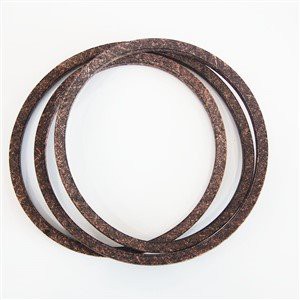
When I first started working as a banded wedge belt supplier, I’ll admit I didn’t give pulley diameters much thought beyond “make sure it fits.” That was a mistake. Early on, I got a call from a small manufacturing client who’d installed a new motor in their packaging line—their old belts kept snapping within weeks, and they were confused because they’d used the same width as the old setup. When I looked closer, I noticed their new pulley was way smaller than it should have been for a banded wedge belt. That experience taught me that pulley diameter isn’t just a technical detail; it’s the difference between a belt that runs smoothly for years and one that causes costly downtime. Today, I’m here to break down what the recommended pulley diameter is for banded wedge belts, why it matters, and how to get it right for your application.
First, let’s ground ourselves in what banded wedge belts are and how they work. Unlike standard V-belts, banded wedge belts are constructed by bundling multiple individual wedge-shaped V-belts together with a continuous nylon band on the top. This design gives them extra stability, reduces vibration, and distributes load more evenly across the belts—perfect for applications that need high torque or run at high speeds. You can learn more about their construction and uses by checking out our page on Banded Belts, but for now, the key point is that their performance depends heavily on how they interact with pulleys.
Pulley diameter affects banded wedge belts in two big ways: bending stress and power transmission efficiency. When a belt wraps around a pulley, it has to bend, and that bending creates stress in the belt’s core—usually made of high-tensile cords like polyester or aramid. The smaller the pulley, the sharper the bend, and the higher that bending stress gets. Too much stress, and the cords can fatigue, break, or pull away from the rubber matrix, leading to premature belt failure. On the flip side, a pulley that’s too large adds unnecessary bulk and cost, plus it can increase the overall size of the drive system, which isn’t ideal for space-limited setups.
So what’s the actual recommended pulley diameter? The short answer is: it depends on the belt’s section type. Banded wedge belts come in standard sections, each with a minimum recommended pulley diameter (and a preferred diameter for optimal performance). Let’s go through the most common sections and their guidelines, based on industry standards like those from the Rubber Manufacturers Association (RMA) and our own decades of supplying these belts to clients across agriculture, manufacturing, and HVAC.
For the light-duty wedge sections, like AX and BX (common in smaller motors and light machinery), the minimum recommended pulley diameter is 3.15 inches (80 mm) for AX and 5.12 inches (130 mm) for BX. But wait—those are minimums. If you can go larger, I always recommend it. Our data shows that using a pulley that’s 20-30% larger than the minimum reduces bending stress by up to 40%, extending belt life significantly. For example, a client in the garden equipment industry was using BX banded belts on a pulley that hit the minimum 5.12 inches; after switching to a 6.3-inch (160 mm) pulley, their belt life went from 3 months to over a year. You can see how these belts perform in light-duty applications specifically by looking at our Wrapped V-belts for Garden Technic page, which includes recommendations for pulley sizing tailored to garden machinery needs.
Moving to medium-duty sections, like CX and DX, which are used in medium motors and industrial conveyors, the minimum pulley diameter jumps to 7.09 inches (180 mm) for CX and 9.45 inches (240 mm) for DX. Here again, going slightly above the minimum is smart. One of our motor drive clients, a small auto parts manufacturer, was struggling with CX banded belts slipping intermittently on their conveyor drive. Turns out their pulley was exactly at 7.09 inches, which was just enough to meet the minimum but not enough for consistent power transmission. We suggested upsizing to 8.66 inches (220 mm), and the slippage stopped—plus, the belts now run cooler, which is another benefit of proper pulley sizing. You can find more details on how these belts work in motor-driven systems on our Motor Drive Belts page, including a sizing chart that outlines pulley diameters by section.
For heavy-duty banded wedge belts, like EX and FX (used in large industrial equipment, mining conveyors, and agricultural harvesters), the stakes are even higher. The minimum pulley diameter here is 12.6 inches (320 mm) for EX and 15.75 inches (400 mm) for FX. These belts handle massive torque, so bending stress is a critical factor. We’ve seen cases where a mining client tried to use an EX belt on a 11.8-inch (300 mm) pulley to save space—within a month, the belt’s core cords snapped, causing hours of downtime. Upsizing to the recommended 12.6-inch pulley fixed the issue immediately, and their production rates stayed consistent. If you’re working with heavy-duty applications, it’s worth checking our dedicated page for Banded Wedge Belt, which includes full section specifications and pulley diameter guidelines for heavy loads.


Now, it’s not just about the nominal diameter—there’s also the pulley’s groove profile to consider. Banded wedge belts work best with pulleys that have a matched wedge groove angle, usually 40 degrees. If the groove angle is off, even a correctly sized pulley won’t seat the belt properly, leading to uneven load distribution and higher stress. Also, make sure the pulley’s groove depth and width match your belt’s section; a groove that’s too shallow can cause the belt to ride too high, while one that’s too deep reduces contact with the pulley, leading to slippage. I’ve seen too many clients mix and match groove sizes with belt sections, so double-checking these details is just as important as getting the diameter right.
Another factor that affects pulley diameter recommendations is the drive’s speed ratio. Speed ratio is the driven pulley diameter divided by the driving pulley diameter. If your drive has a high speed ratio (say, 4:1 or higher), the driven pulley will be much larger than the driving pulley, but the driving pulley still needs to meet the minimum diameter for the belt section. For example, if you’re using a BX banded belt in a drive with a 5:1 ratio, the driving pulley can’t be smaller than 5.12 inches, even though the driven pulley might be 25 inches. The driving pulley is where the belt experiences the most bending, so its size is non-negotiable. I once had a client who tried to get away with a smaller driving pulley to keep their speed ratio tight, and within two weeks, the belt’s band started peeling off—lesson learned.
Heat is another byproduct of incorrect pulley diameter. When a belt bends too sharply on a small pulley, it generates more friction and heat, which breaks down the belt’s rubber compound over time. Banded belts are more heat-resistant than standard V-belts, but they still have a limit. If your belts are running hotter than 180°F, check your pulley diameter—chances are it’s too small. Our quality team tests every banded wedge belt we supply under different pulley size conditions, and we’ve found that sticking to the recommended diameter keeps operating temperatures 15-25°F lower than using a minimum-sized pulley. That extra heat reduction translates directly to longer belt life.
I also want to address a common misconception: some people think that larger pulleys always mean better performance, but that’s not true. If you go way above the preferred diameter, you’re wasting material, increasing costs, and making the drive system larger than necessary. For example, an AX banded belt has a preferred pulley diameter of 4.7 inches (120 mm) to 6.3 inches (160 mm), but going up to 10 inches (250 mm) won’t give you any additional benefit—it’ll just cost you more. Stick to the range that’s recommended for your belt’s section, and you’ll get the best balance of performance, longevity, and cost.
So, how do you measure your current pulleys to make sure they’re correct? Grab a tape measure and measure the outer diameter of the pulley—don’t just go by the part number, because sometimes pulley manufacturers have slight variations. Also, check for wear: pulleys can wear down over time, getting smaller in diameter, which is the same as using a too-small pulley. If your pulleys show signs of grooving or uneven wear, it’s a good idea to replace them or have them machined back to the correct diameter. We supply pulleys matched to all our belt lines, including our High Quality Classical Wrapped V-belt series, so we can help you pick the right combination for your drive.
At the end of the day, the recommended pulley diameter for banded wedge belts is a balance of technical guidelines and real-world application needs. It’s not a one-size-fits-all number, but it’s a critical detail that can make or break your drive’s performance. If you’re not sure what size you need for your specific setup, don’t guess—reach out. We’ve been supplying banded wedge belts to clients across industries for years, and our team can help you calculate the right pulley diameter, match it to the correct belt section, and make sure your drive runs smoothly. Whether you’re dealing with a small garden tool or a heavy industrial conveyor, we’ve got the expertise and products to get it right. If you have questions or need to place an order, feel free to connect with our team to discuss your requirements.
References
Rubber Manufacturers Association. (2021). Standard Practice for V-belts and Sheaves. RMA Publication IP-20.
Society of Automotive Engineers. (2019). Belt Drives for Industrial Machinery. SAE International Report J1117.
Nitta, K., & Tanaka, T. (2020). Bending Stress Analysis of Banded V-belts for High-Torque Applications. Journal of Mechanical Design, 142(6), 063301.